
Various operations use conveyor belts to transfer materials. These include coal, minerals, cements, sand, and so on. However, these materials sometimes get stuck on the belt, which can make the belt dirty. That’s where conveyor belt cleaners come in handy. However, there are two primary types: primary vs secondary belt cleaners.
Interestingly, both types are used on the same belt. They are not two different devices but are two parts of the same cleaning operation. The primary cleaner is installed at the head pulley for more aggressive cleaning. In contrast, the secondary cleaner is installed after the head pulley to remove residue left by the primary cleaner. In this article, I will explore the key differences between primary and secondary belt cleaners.
What are Conveyor Belt Cleaners?

Before differentiating primary and secondary, let’s first understand the basics of belt cleaners.
Conveyor belt cleaners are devices installed on the conveyor belt. They use special blades that remove the leftover material. Primary belt cleaners are designed for aggressive cleaning. It removes 70–80% of the carryback from the belt. Secondary cleaners assist primary belt cleaners, which are used for soft cleaning. It removes the remaining 20–30% of the material (fine particles) that escape the primary cleaner.
As I said earlier, conveyor belts are used in different applications. These include food processing, mining, construction, and materials handling. Their role is to carry the material and discharge it at specific points. At the discharge point, most of the materials are removed. However, some materials stick to the belt’s surface and do not come off.
In every cycle, some materials remain on the belt surface. This leftover material on the belt, called carryback, impairs the belt’s operation. These materials keep accumulating and can affect various parts of the conveyor system. To remove this carryback, the conveyor belt cleaner or scrapers are used. There are two primary types of these cleaners:
- Primary conveyor belt cleaner
- Secondary conveyor belt cleaner
The primary cleaner is mounted on the head pulley, while the secondary cleaner is mounted after the head pulley. These belt cleaners use blades that push against the conveyor belt as it moves. As a result, the blades effectively remove the stick materials from the belt. The primary conveyor belt cleaner is most important because it removes almost 70% of carryback. The secondary belt cleaner is only suitable for removing small particles that escape the primary cleaner.
Differences Between Primary and Secondary Conveyor Belt Cleaners
The primary difference between these cleaners is their level of efficiency. The primary conveyor belt scrapers aggressively clean sticky materials. It leaves only a small amount of material to escape and be transported to the secondary cleaner. The secondary belt cleaner is designed for only light cleaning and removing small particles.
Let’s drill down and compare these two belt scrapers head-to-head.
1- Position & Role
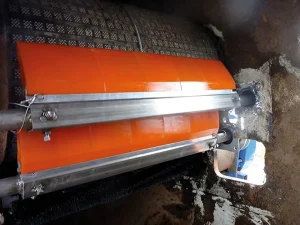
Primary conveyor belt cleaners are present at the head pulley. This is the point where the belt turns around after discharging the materials. Primary cleaners clean the sticky materials immediately as the belt discharges material. It takes a major portion of leftover materials.
The role of this cleaner is to remove the heavy and sticky leftover materials. On the other hand, the secondary conveyor belt cleaner is located next to the head pulley. It is positioned on the return side of the belt for the next cycle. The secondary cleaners remove any remaining particles, ensuring the belt is perfectly cleaned for the next cycle.
2- Cleaning Level & Efficiency
Both primary and secondary belt cleaners differ in their cleaning levels. The primary conveyor belt cleaner is the main device that cleans all the major sticky materials. It removes 70-80% of leftover materials. Only 20-30% of the material remains on the belt, which the secondary cleaners then address and clean.
These secondary cleaners remove the remaining 20–30% of carryback, which is generally in lighter particles. The efficiency of this second line of defense is up to 99%. This means that the belt after secondary cleaners is very clean and doesn’t have any carryback. In terms of cleaning quality, the primary cleaner is more aggressive. That’s because it cleans the belt more aggressively and removes thicker, heavier, and stickier materials.
3- Pressure on the Belt
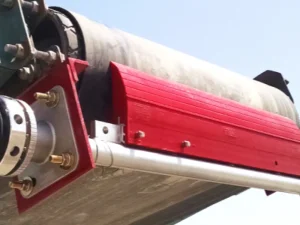
Primary conveyor belt cleaners are designed for aggressive cleaning. So they press the blade against the conveyor belt with higher pressure. This means there is stronger contact between the blade and the belt. This strong contact removes the stickiest materials from the belts, making them cleaner.
In contrast, the secondary conveyor belt cleaners are designed for lighter cleaning. This cleaner gently presses the blade against the belt to remove particles and less-sticky materials. That’s why the secondary cleaners remove only 20-30% of the leftover material; the primary cleaners remove the bulk. In short, primary cleaners always apply more pressure on the conveyor belt.
4- Blade Type & Safety
As previously mentioned, these conveyor belt cleaners use blades for cleaning operations. The primary conveyor belt cleaners use durable, rugged blades. Why? That’s because this blade is intended for removing sticky materials. It is pressed firmly against the belt, so it must be strong enough to withstand this harsh use.
Generally, manufacturers use tungsten carbide to make this blade. On the other hand, secondary cleaners use softer blades as it only removes lighter suspended particles. When it comes to safety, both of these cleaners offer excellent safety. However, it is crucial to ensure these belt cleaners are correctly installed on the conveyor system.
5- Durability & Wear Rate
Both primary and secondary belt cleaners are also different in durability and longevity. The primary belt cleaners consist of a strong blade for cleaning. So many believe this cleaner is more durable with a lower wear rate. However, this is not true, as primary conveyor belt cleaners are less durable and have a higher wear rate. Why?
The reason is that the blades of these scrapers are subjected to greater forces and remove sticky materials. So it is used more aggressively, which speeds up its wear. Conversely, the secondary conveyor belt cleaner has less blade strength. However, it is used for gentle cleaning rather than aggressive cleaning. So blades remain in good condition for years to come and remain durable. Their wear rate is much lower than that of the primary conveyor belt cleaner blade.
6- Material handled & Installation Complexity
The primary belt cleaner handles heavier, stickier materials. In fact, it sometimes handles abrasive materials when used on mining or construction sites. Therefore, these cleaners are made robust, with blades strong enough to withstand harsh materials. The secondary belt cleaners only handle the particles, dust, debris, and other residual material.
This means the secondary cleaners are more at ease with materials handling. Remember, primary belt scrapers are easier to install. The reason is that they don’t require proper alignment and can be installed on the head pulley. However, installing a secondary conveyor belt cleaner is very difficult.
That’s because these cleaners must be installed at precise alignment at the return side of the conveyor belt. The misalignment can affect the working of these cleaners. In the event of misalignment, the secondary blade may not make contact with the belt. As a result, dust residue can accumulate beneath the blade, reducing its efficiency in clearing. The margin of error is small when installing the secondary conveyor belt cleaners.
7- Lifespan & Replacements
You’ll see people saying that primary conveyor belt cleaners require more frequent replacement. That’s true—these cleaners wear out more quickly. The reason is that the blades of these cleaners press forcefully against the belt. They remove stubborn, hard-to-remove materials.
This causes the blade to wear out quickly and requires replacing these cleaners. In contrast, the secondary belt cleaners don’t need to be replaced too often. The reason is that the blades on these cleaners do not come into contact with harsh materials. These blades only handle mild cleaning, not aggressive cleaning. So these blades last longer, reduce replacement costs, and improve the lifespan of these belt cleaners.
8- Cost & Maintenance
Primary conveyor belt scrapers are typically cheaper and require more regular maintenance. As I said, the blades of these cleaners are made with heavy-duty materials such as tungsten carbide. This material is very expensive, which increases the manufacturing costs of primary belt cleaners. Since it is used aggressively during cleaning, the risk of wear and tear is high.
So you’ll have to spend more on its regular maintenance, which can be a drawback. On the flip side, the secondary conveyor belt cleaners are used for mild cleaning. Their blades are made of less expensive materials. That’s why these belt cleaners are relatively affordable compared to their counterparts. Apart from the cost perspective, these belt cleaners require less frequent maintenance.
Frequently Asked Questions
Should I choose primary or secondary scrapers?
Ideally, both primary and secondary scrapers should be used in a conveyor belt. This ensures your conveyor belt remains perfectly clean, even when handling harsh materials. If there is no option but to choose one, I recommend primary scrapers, as they remove 70-80% of sticky materials.
How often do I replace the scrapers?
You should simply replace scrapers if their blades show signs of deterioration or wear out. Therefore, I recommend regularly inspecting the blades of these cleaners. If scrapers are used more often, they are more likely to be replaced more quickly, and vice versa.
How often should belt cleaner blades be replaced?
Belt cleaner blades should be replaced; they show signs of wear. Such blades may not do perfect cleaning. Worn-out blades, especially in primary scrapers, show significantly reduced performance. They may only clean 30–50% of sticky materials. It is best to replace them once you notice their performance degrading or any wear.
Conclusion
Let’s conclude – both primary and secondary belt cleaners are equally important. They keep the conveyor belt clean even when it is being used to transport harsh materials. Remember, the primary cleaner is always given more value because it is involved in aggressive cleaning. It removes sticky, leftover materials and can even handle harsh, abrasive materials.
Secondary cleaners are helpers who remove residual material left by primary cleaners. I recommend using both of these belt cleaners to keep the conveyor belt as clean as possible. In this article, I have discussed the basics of primary and secondary belt cleaners and compared them head-to-head.