Transporting materials to steep heights was a problem in the past. Workers had to carry materials, which was very tiring. Conveyor belts were not efficient enough to effectively transport materials at steep heights. That’s where chevron conveyor belt systems came in handy. Despite their importance, many people still lack a clear guide on chevron conveyors.
Due to a lack of knowledge, many people do not take full advantage of these conveyor belts. The Chevron conveyor is unique due to the pattern present on its belt surface. This pattern allows the belt to carry materials at steep heights by providing support. In this article, I will provide all the information about chevron conveyor belts. So, let’s get started.
What is a Chevron Conveyor?
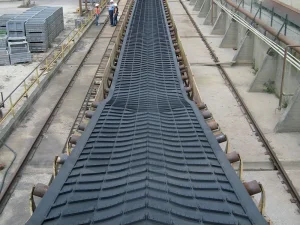
The Chevron conveyor system comes with a belt featuring a specific V-shaped pattern. This pattern makes it unique among conveyor belts. It provides grip for the loaded materials so that they don’t slip. Due to this, this belt is very popular for moving materials up steep inclines, as the ridged pattern prevents the material from falling off.
Conveyor belts have been in use for several decades, right? However, they were not as advanced as they are now. In the early days, these belts were very compromised in terms of their performance. They could only operate on level ground or gentle slopes, carrying materials from one place to another. However, they were not suitable for transporting materials to high heights.
So workers had to carry materials and transport them, which was very tiring for them. However, the chevron conveyor belts were designed to transport materials up steep inclines. As I said, chevron conveyors have a unique belt pattern. This pattern can have a distinct V-shape across the entire belt surface. In some cases, it can also be zig-zag lines or patterns.
The purpose of this pattern is to provide grip to the loaded materials. When the belt moves, the materials do not fall off because the pattern (grip) holds them well in place. These chevron conveyor belts have become very popular in construction, mining, and food sectors. One thing I like about Chevron conveyors is that they can even transport material at angles up to 45 degrees.
Above all, you can also transport bulk materials using a chevron conveyor. This system effectively transports materials at optimal speed at height. This has eliminated the need for expensive lifts or bucket elevators. Before these conveyors, people relied on lifts or bucket elevators for this type of transportation.
Construction and Components of Chevron Conveyors
In the section below, I will discuss the structure and key components of this conveyor system.
- Belt with Pattern
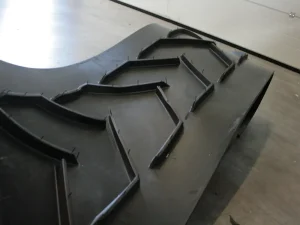
The Chevron conveyor consists of a belt with a pattern (ridges) on it. This belt is generally made of either PVC or rubber and is very strong. It can withstand harsh materials without deterioration. Some belts of chevron conveyors are also heat and chemical-resistant.
- Estrutura de aço
The frame is a skeleton that supports all the essential components of a chevron conveyor. Since it holds all the components, it is made with stronger materials. As a result, it can withstand loads and remain in good condition for longer. Most chevron conveyors come with steel frames.
- Drive System
The Chevron conveyor also comes with a drive system. This system includes a dedicated electric motor, pulley, and gearbox. This system ensures that belts move with optimal speed. This conveyor system has two pulleys. These include the drive and idler pulleys, both of which are equally important.
- Rollers & Idlers
Chevron conveyors have both rollers and idlers. These components are present underneath the belt. Their role is to support the belt’s weight and prevent it from contacting the surface. You might have noticed that when the chevron conveyor runs, the belt never sags. This is because of these rollers and idlers.
- Supporting Frame or Sidewalls
Sidewalls are support frames at the edges of the belt. These side walls help prevent material from falling off when moving at steep angles. Materials loaded onto the belt do not fall off as the belt moves upward due to these sidewalls. First, V-shaped patterns provide grip to keep materials in place. Sidewalls further protect the material from falling from the chevron conveyor belt.
How Does a Chevron Conveyor Work?
The working of the chevron conveyor belt system is very straightforward. First things first: this conveyor belt is used to carry materials at high heights. For this, it handles materials transportation at a steep angle. First, the materials to be transported are loaded onto the chevron conveyor belt. This belt has a dedicated V-shaped pattern or set of ridges.
These ridges or raised patterns provide grip for the loaded materials. As a result, the material, such as sand, bricks, or any other things, does not slip away. Once the material is loaded at a lower height, the conveyor belt starts to move. It takes material from lower to higher heights and handles steep angles perfectly.
Since the loaded material has a good grip, it does not move when the belt is at a high angle, such as 30 or 40 degrees. Sidewalls of these chevron conveyor systems protect the loaded material from falling off. Once the material reaches the desired discharge point at a higher height, it is discharged there. Loading and unloading are generally manual when using the chevron conveyor system.
This means some humans load the materials. Raised ridges are what set a chevron conveyor belt apart from a regular one. Due to these ridges, the material remains firmly in place during transportation. Even if the conveyor belt moves at high speed and takes material at a steep angle, the material remains in place. You won’t notice any spillage thanks to ridges and sidewalls.
Applications of Chevron Conveyors
Chevron conveyors have become a vital tool across various industries. In fact, their use makes material transportation and handling much easier. Many industries stopped using heavy-duty lifting machines. Why? The reason is that chevron conveyors are more affordable than those lifts and do the job just as well. Let’s explore key applications of chevron conveyors.
1- Mining Sector
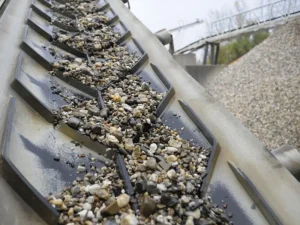
Chevron conveyor belts are widely used in the mining industry. In fact, they are a must-have for underground mining. As you know, miners extract different minerals, ores, coal, and other materials during mining. However, transporting these materials from underground pits can be very difficult. So, they load the material on the chevron conveyors and transport it outside. These belt systems transport mined material with ease, even at steep levels.
2- Construction Industry
The construction industry has widely benefited from chevron conveyors. As you know, modern buildings have multiple floors and stories. In construction, transporting materials such as gravel, sand, and concrete can be difficult. If done manually, transporting construction materials can be slow. That’s why modern construction sites use chevron conveyors. This way, they transport material quickly, ensuring construction happens at a rapid pace.
3- Large Shopping Malls
In the past, shopping malls were not multiple stories. So logistics transportation, such as packet cartons, was much easier. However, things have changed, as shopping malls are no longer in plazas with many floors. Therefore, these malls rely on chevron conveyor belts to transport logistics to different floors. If they don’t use these conveyors, they would hire more labor, which would cost more. Transporting goods to different floors by hand would be very slow and inefficient.
4- Agriculture Industry
As you know, the materials such as wheat, grains, and other items are stored in the large tanks or silos. This transportation is also done using chevron conveyors. At a large scale, this material transportation can be time-consuming. The belt in the conveyor system has ridges that prevent wheat or grain from slipping.
This way, these food items are sent to silos without being wasted. Not only for grain or wheat, but this chevron conveyor is also useful for storing fertilizers. However, this usage is only common at a large scale. For small-scale operations, manual processes are used to store wheat and other food items.
5- Food Industry & Sugar Refineries
Food items are made in large factories. Their production involves different steps. These items are moved from one location to another for processing, packaging, and related activities. For this type of transportation, chevron conveyors are common. This belt system carefully carries the food items without causing spillage.
In fact, this system is so secure that it can even transfer semi-solid food items without wasting them. Using a regular conveyor belt system may not be as effective as a chevron in the food industry. Remember, this conveyor system is also very useful in sugar refineries. How? That’s because it helps transport raw sugar and crystals from one processing stage to another.
6- Waste Handling
The waste materials, such as plastics, are generally recycled. This way, these materials are reused, preventing environmental pollution. The chevron conveyor belt system is effective for transporting waste.
They take the waste to recycling plants, where it is recycled. During this transportation, the waste does not fall off. This chevron belt discharges the materials into the recycling machine or unit. This means all the wasted materials are recycled without requiring human intervention. Once loaded onto the belt, the conveyor system handles everything.
Advantages or Benefits of Chevron Conveyors
Chevron conveyors offer many benefits over conventional conveyor belts. That’s why you’ll see many industries shifting towards Chevron. Some of the key benefits of these conveyor belt systems are as follows:
- Steep Incline: First, the chevron conveyor can help transport material at steep angles. For example, you’ll be able to send material even at a 45-degree angle. This means that transporting materials to higher levels becomes much easier with these conveyors.
- Reduced Spillage: The belt of the chevron conveyor comes with V-shaped patterns. These patterns are raised ridges that provide grip for materials. So loaded materials remain secure in their place and do not slip or fall off when moved at a steep angle. This results in no spillage or wastage of the loaded materials.
- Improved Efficiency: One of the primary advantages of the chevron conveyor is that it can operate at higher speeds. This means you’ll be able to transport the materials very quickly. This is very important for busy shopping malls and mining operations. Materials transport will be both safer and quicker, improving efficiency.
- Compatibilidade de materiais: The belt of the chevron conveyor is very rugged and durable. They are made with rubber having multiple layers. These belts can withstand a wide range of materials, including coal, ores, food products, gravel, and concrete. This makes the chevron conveyor system very versatile for a wide range of industries.
- Bulk Material Handling: The chevron conveyor may seem compact. However, their belt size is optimal and can handle bulk transportation of the materials. Additionally, the electric motors used in these conveyor systems are very strong. So it will quickly move the belt regardless of the load on the conveyor belt. This is very useful in bulk transporting of materials in busy industries.
Chevron Conveyor Belt Cost and Value
Chevron conveyor belts are more expensive than regular conveyor belts. That’s mainly because of the V-shaped pattern present on their belt. The sidewalls and V-shaped patterns are some additional components that increase its cost. However, these components enable the conveyor to transport the material at higher heights and steep angles.
Due to higher prices, many are unsure whether to choose a chevron belt. In my opinion, the selection of the chevron conveyor comes down to your specific use case. These conveyor systems provide value if you want to transport materials at a steep angle or at a higher height. However, if your use does not involve transporting material at high speeds, I recommend skipping the chevron conveyor. In such cases, regular conveyor belts with no pattern work fine.
Conclusão
Let’s conclude – chevron conveyor belts are undoubtedly the best invention for modern industries. You may not see these conveyors used on a smaller scale. This is because their price is slightly higher than that of regular conveyor belts. However, their effectiveness is very prominent in shopping malls, refineries, and construction sites. This chevron conveyor system is effective for moving materials from lower to higher levels. In this article, I explained everything about the chevron conveyor, which will help you decide about its selection.