
Conveyor belts are considered must-haves for all modern industries. They help transport and handle materials efficiently without requiring a large investment. However, there is a fascinating history of conveyor belts that has shaped their evolution. It is worth noting that these belts are not a new invention.
Instead, they have been in use for centuries. In the early days, these conveyors were manual and made of wooden materials. As a result, they were less durable and had limitations. Over the years, they underwent changes and modifications, giving us highly efficient belts today. In this article, I will discuss the creation of conveyor belts and their history. So, let’s get started.
History and Evolution of Conveyor Belts
As I said above, conveyor belts underwent different changes and modifications. Initially, they were made of wood, and their belts were made of leather. Things have changed today, as steel is now the primary material used in their frame, rollers, and other components. The conveyor belt itself is made of rubber and consists of three layers.
These multi-layer designs give these belts strength and durability. Above all, their middle layer, also called the reinforcement layer, consists of steel cords. As a result, the conveyor belts are stronger, more durable, and longer-lasting. However, in the section below, I will discuss the development of conveyor belts across different eras.
1- Beginning of Conveyor Belts in the Late 1700s

The concept of conveyor belts dates back to the late 1700s. At that time, ports were used to transport different materials. However, loading and unloading of these materials were challenging. Workers had to handle the materials manually, which was tiring and time-consuming. That’s where the concept of the conveyor belt came from.
So, ports started using very basic conveyor belts. They were made of wooden material with a leather belt. It had no automation and required human intervention for its operations. However, it is better than labor-intensive hand loading of the material. These basic conveyor belts were able to load more material quickly despite their manual operation. These conveyor belts had pulleys and a crank. Workers had to operate these belts manually using a hand crank.
2- Introduction of Steam Conveyors in the Early 1800s
The early wooden-and-leather conveyor belt proved a great help to workers. However, they required human effort to hand-crank and operate these belts. In 1804, manufacturers started using steam engines with conveyor belts. This was the first step towards automation, reducing human effort in operating the conveyor belts. At that time, steam engines were common. The conveyor belts with steam engines became more efficient and faster. However, these belts were also made of wood and leather. This means they were not very durable, which was a significant drawback.
3- Use in Agriculture and Grain Handling in 1830s–1840s
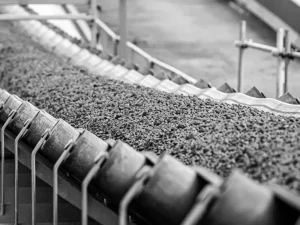
The British Navy initially used steam-powered conveyor belts. The Navy relied on these belts for its food production. Due to their superior performance, these conveyor belts quickly became popular. In the 1830s, many farmers began using these belts for various agricultural activities.
Before conveyor belts, the collection and handling of grain was a very challenging process. Farmers had to spend days carefully collecting the grains. However, with conveyor belts, grain handling became effortless. This resulted in better productivity in agricultural needs. Later, these conveyor belts also began to attract attention across different industries.
4- Introduction of Vulcanized Rubber in 1844
Conveyor belts powered by steam engines were powerful. However, the belts of these conveyor systems were weak and prone to degradation. They were not resistant to moisture and high temperatures. This was a significant drawback, and customers had to change the belt more often. That’s where the introduction of vulcanized rubber became handy in 1844. This vulcanized rubber was durable, strong, and resistant to high temperatures. This reduced the major limitation of old steam-based conveyor belts. Made from vulcanized rubber, these belts offer excellent durability and longevity.
5- Thomas Robins’ Efforts to Make Conveyors for Coal and Ore Handling (1892)
Until 1891, conveyor belts were not robust enough for use in the mining industry. That’s because of the weaker belt. However, in 1892, Thomas Robins introduced steel cables as reinforcement in the middle layer of the belts. These steel cables improved the strength of these belts. As a result, they were able to withstand more load and harsh usage.
Thomas Robins was an American engineer who also improved conveyor belt rollers in 1901. He used steel to make rollers. As a result, these rollers became more durable and able to withstand greater loads. This progress led to the use of conveyor belts in mining industries. Before this, the mining industry relied on railcars, which were inefficient. As a result, the miners had to put more effort into transporting the mined material off the site.
This reliance on human effort made the mining processes very slow. Mining companies had to spend months on simple mining operations. However, the conveyor belts with steel cables changed everything. Remember, the improved conveyor belts were able to withstand ore, coal, and other materials. After this improvement, the rubber belts with steel reinforcement became popular.
6- Henry Ford Used Conveyor Belt Moving Assembly Line
In the early 1900s, automobile manufacturing was slow and less efficient. Henry Ford, in 1913, first used a conveyor belt as their moving assembly line. In their manufacturing facilities, the use of conveyor belts made things easier. The transportation of different automobile parts and components became easier.
This reduced the hassle for workers who were used to manually transporting materials and automobile parts. Now, they had to load parts on the conveyor belt, and the parts reached the specific location in no time. This made the production of cars much more efficient. The Ford Motor Company was a pioneer in the use of conveyor belts in the automobile industry. Later, other automobile companies also started using conveyor belts to improve their productivity.
7- Era of Improvements (1920s – 1950s)
After the 1920s, different industries started using conveyor belts for bulk transportation. This was because the belt became very strong with the introduction of steel cables. This gave companies the confidence to use belts even for long-distance material transportation. Later, manufacturers also used different materials to make these belts.
These include nylon, polyester, and more. Each of these materials gave the conveyor unique properties. Manufacturers also tried different electric motors for running these conveyor belts. Some motors were large enough to run the conveyor even when overloaded. Such belts were commonly used in heavy-duty applications.
8- Involvement of Automation in the 1960s and 1980s
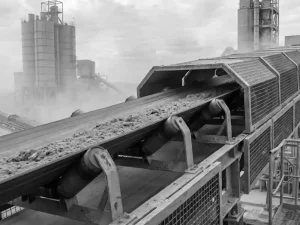
Until the 1950s, manufacturers were focused on the mechanical aspects of conveyor belts. However, after this, competition among the conveyor belts became ferocious. Every company wants to make a conveyor belt better than others. That’s where they started using electric motors, sensors, control panels, and so on.
These advancements made conveyor belts more automated. Later in the 1980s, conveyor belts with dedicated computerized systems were introduced. These conveyor belts were highly efficient and safe. They had an automatic on/off switch as well as an emergency stop button. This resulted in conveyor belts becoming more efficient and productive.
9- Focus on Energy Efficiency in the 1990s
After the 1990s, manufacturers began producing energy-efficient conveyor belts. Interestingly, these belts had a high load capacity but still consumed less power. The introduction of energy-efficient drive motors made them highly efficient.
Additionally, manufacturers also optimized the conveyor belts to improve their load capacity. Conveyor belts made in the 1990s were highly durable and long-lasting. The regular wear and tear was negligible, resulting in low maintenance costs. Remember, these belts were also automated, which was another significant advantage.
10- Automation in the 2000s to the Present
Since the 2000s, conveyor belts have become automated and faster. They don’t need workers for their operations. Instead, operators switch on the conveyor belt once, and it will keep running. Their advanced sensors and safety buttons make them highly safe. Additionally, they also come with a modern discharge system. This means they can automatically unload the material at the destinations.
Interestingly, manufacturers also make incline conveyor belts. These conveyor systems are ideal for transporting materials to higher heights. In the past, transporting materials at great heights was very challenging. Additionally, the conveyor belt is highly durable. It can even withstand abrasive materials such as sand and gravel. Above all, manufacturers are continuously working to improve and add new features.
Conclusion
Let’s conclude: Conveyor belts have a long history, dating back to the late 1700s. Over the years, they underwent various modifications. Currently, these conveyor belt systems are very advanced and automated. As discussed above, the use of conveyor belts speeds up material transport. That’s why various industries are actively adopting conveyor belts.
You’ll see them being used in different warehouses, manufacturing facilities, shopping malls, and so on. Modern conveyor belts come with advanced features and sensors that make them very advanced. In this article, I have discussed the history and evolution of these conveyors. In the beginning, they were less strong and weaker, more manual. Now, they are powerful and durable, and can be used to transport heavy-duty material over long distances.